WordPress Agency Recurring Revenue: 5 Models That Scale

One $10K project every three months feels good until you try to forecast next quarter. Ten clients at $100/month is less dramatic — but it's predictable, scalable, and it lets you actually hire people. WordPress agency recurring revenue isn't about picking one model and hoping. It's about stacking five proven approaches until projects become optional.
In this post:
The Problem: Agency Revenue Unpredictability
Most WordPress agencies run on projects. A $15K build lands in January, nothing in February, a $8K redesign in March. Revenue is lumpy, forecasting is guesswork, and every dry spell feels like a crisis. You can't hire against project revenue — one cancellation and you're overstaffed.
The math tells the story. A single $10K project every quarter gives you $40K annually, but zero visibility into next month. Ten clients paying $100/month gives you $12K annually from those same relationships — except it arrives predictably, compounds as you add clients, and makes your business worth more when you sell it. SaaS companies command 40-100x MRR multiples at exit. Service companies get 1-3x profit. The structure of your revenue changes what your business is worth.
Agencies with 50%+ recurring revenue can hire with confidence, forecast accurately, and command higher valuations. The target: 70% of total revenue from recurring models within 24 months.
The good news: WordPress agencies are uniquely positioned for recurring revenue. Every site you build needs ongoing maintenance, monitoring, updates, and reporting. The question isn't whether to build recurring revenue — it's which model to start with. There are five proven approaches, and the best agencies stack multiple models together.
Five Recurring Revenue Models for WordPress Agencies
Each model below is legitimate and scalable at different rates. None is universally "best" — they serve different agency sizes, client profiles, and growth stages. Here's what matters when evaluating them: margin (what you keep after costs), complexity (how hard it is to deliver), scalability (whether 100 clients requires 100x the effort), client retention (how sticky the model is), and implementation effort (how long until your first client is live).
Model 1: Care Plans (85-95% Margin)
WordPress care plans bundle security updates, plugin compatibility checks, performance monitoring, backups, and monthly reporting into a single monthly fee. Month one takes 5-10 hours per client for setup and baseline audits. Months two onward: 30 minutes to an hour per client, mostly automated.
The numbers work because the labor drops off a cliff after onboarding. At $60/month average with $5-7 in tool costs, you're keeping $53-55 per client. Fifty clients at that rate produce $2,750 in monthly profit from roughly 25 hours of work — most of which is monitoring dashboards and reviewing automated reports.
Client retention sits at 90%+ when you include monthly reports. Without reports, retention drops to 40-60%. The report is the receipt — it's proof that the money your client spends is working. Agencies that send monthly reports see dramatically lower churn because clients can see the value. That's the core retention lever that keeps churn below 5%.
Model 2: Retainer Hours (40-60% Margin)
Retainer hours sell blocks of design, development, or strategy time at a monthly rate. A client paying $1,500/month for 10 hours at $150/hour gets ongoing access to your team for whatever they need — landing pages, content updates, UX improvements, strategic consulting.
Margins are lower (40-60%) because you're selling labor, not automation. The constraint is team capacity: 20 retainer clients at 10 hours each is 200 hours of billable work per month. You need a team to deliver it. But the billing rate is premium, and these clients tend to be larger businesses with real budgets.
Use retainer hours for clients who need ongoing strategic work beyond maintenance. It pairs well with care plans — the care plan handles the automated baseline, the retainer covers the custom work. Retention runs 60-70%, lower than care plans because the value perception resets each month ("What did I get for my $1,500 this month?").
Model 3: Hosting Resale (20-30% Margin)
Hosting resale is the simplest model. Sign up as a reseller or affiliate with WP Engine, Kinsta, or Flywheel. Pay $50/month for a plan, charge your client $80/month. You keep $30 and the hosting provider handles infrastructure, support, and scaling.
Margins are thin (20-30%) but the model has two advantages: it's nearly zero effort to deliver, and clients rarely switch hosting providers. Retention sits around 80% — not because clients love the service, but because migration is painful. The real play is bundling: care plan ($60/month) + hosting ($80/month) = $140/month package with combined margin of 52%. The client sees a "full package" and you've locked in two revenue streams. The key is proving that value monthly — a well-structured client report template makes the bundled price feel justified.
Model 4: Performance Monitoring (70-85% Margin)
Performance monitoring tracks uptime, Core Web Vitals (LCP, FID, CLS, INP), page speed, and delivers monthly performance reports. It's highly automated — monitoring tools do the heavy lifting, you provide the branded report and optimization recommendations.
At $19-$49/month, it's a lower price point than care plans, which makes it an easy upsell. E-commerce sites and high-traffic businesses are the best targets because performance directly impacts their revenue. Margin is 70-85% (monitoring tools cost $3-8/client). Retention is 75-85% — valuable, but replaceable by free tools like Lighthouse if clients get cost-conscious.
Model 5: Compliance Monitoring (80-95% Margin)
Compliance monitoring is the newest model and arguably the highest-opportunity. You provide monthly GDPR compliance checks, security configuration audits, plugin vulnerability monitoring, and plain-English remediation reports. As regulatory pressure increases — the EU Cyber Resilience Act takes effect September 2026, GDPR enforcement is tightening, and privacy laws are expanding globally — clients increasingly need proof that their sites are compliant.
Margins match care plans at 80-95% because the work is highly automatable, especially with AI-assisted recommendations. But retention is even stickier at 85-95%: compliance isn't optional. A client might debate whether they need performance monitoring. They don't debate whether they need to comply with GDPR. That's why this model commands premium pricing ($49-$79/month) with minimal pushback.
Most agencies don't offer compliance monitoring yet. That's the window. First movers in this space build authority before the market crowds. If you want to understand the regulatory landscape, read up on what the cookie consent landscape looks like for WordPress agencies — it's one piece of the compliance puzzle.
Comparing All Five Models: The Scorecard
Numbers are useful. Side-by-side comparison is better. Here's how the five models rate across the dimensions that matter for WordPress agencies:
| Model | Margin | Scalability | Retention | Pricing Range | Best For |
|---|---|---|---|---|---|
| Care Plans | 85-95% | Very High | 90%+ | $39-99/mo | Every agency (proven, simple) |
| Retainer Hours | 40-60% | Limited | 60-70% | $1,500-5,000/mo | Premium positioning |
| Hosting Resale | 20-30% | Very High | 80% | $29-299/mo | Easy add-on, bundling |
| Performance Monitoring | 70-85% | Very High | 75-85% | $19-49/mo | E-commerce, high-traffic sites |
| Compliance Monitoring | 80-95% | Very High | 85-95% | $49-79/mo | Regulatory-aware clients |
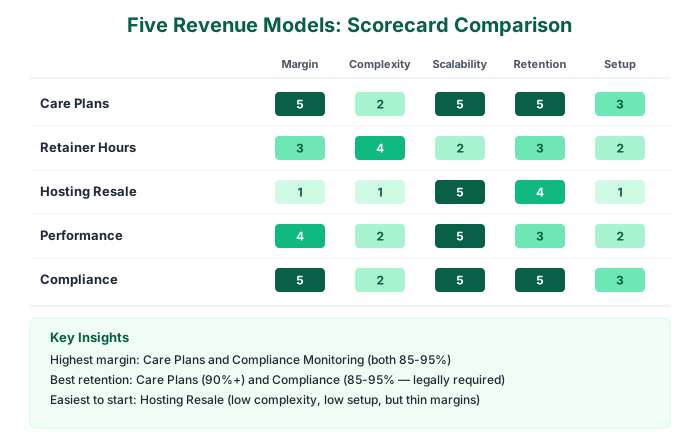
Care plans and compliance monitoring tie for highest margin. Hosting resale is easiest to implement. Retainer hours command the highest billing rates but scale the worst. Performance monitoring sits in the middle — solid margins, easy to automate, but replaceable by free tools if you're not bundling it with something stickier.
Stacking Models: Why the Best Agencies Run Multiple Streams
You don't have to pick one. The agencies with the strongest recurring revenue don't rely on a single model — they stack multiple streams across different price points and buyer profiles. Different clients want different things. Some want maintenance and nothing else. Some want the full suite. Your job is to make every tier available.
Here's what stacking looks like with 20 clients:
- Base: Care Plans — 15 clients at $60 average = $900/month
- Upsell: Performance Monitoring — 8 clients at $30 add-on = $240/month
- Premium: Compliance Monitoring — 3 clients at $60 add-on = $180/month
- Commodity: Hosting Resale — 20 clients at $80 average = $1,600/month
Total MRR from 20 clients: $2,920/month. That's an average revenue per client of $146/month — far above the $100 you'd get from care plans alone. And churn is mitigated across layers: even if a client drops performance monitoring, they're still on a care plan and hosting. Multiple touchpoints mean multiple reasons to stay.
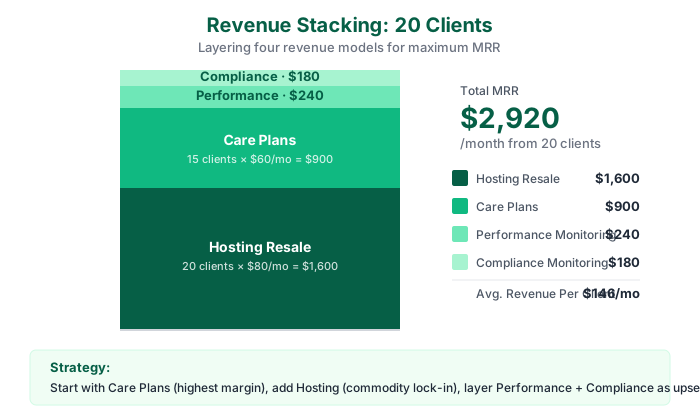
The best agencies treat care plans as the foundation — high margin, proven, easy to automate. Then layer performance monitoring as the natural upsell (lower price point, easy "yes"). Compliance monitoring becomes the premium tier as regulatory pressure builds. And hosting resale runs underneath everything as a commodity lock-in. Most of this stack can be automated. Monthly reports from tools like MantleWP prove the value to clients and keep churn low across every layer. That's how you build a recurring revenue machine, not just a recurring revenue line item.
Building Toward Predictable Revenue
Stacking is the strategy. Timing is the execution. You can't launch five models simultaneously and expect them all to work. Here's a realistic roadmap that builds one layer at a time:
The 90-Day Launch (Months 1-3)
Start with care plans. They're proven, your existing clients already need them, and the conversion rate from project clients to care plan clients runs 40-50% when positioned properly. Develop your care plan packages, pitch your top 5 existing clients in weeks one and two, then scale to your full client list by month two. Target: 5-10 care plan clients and $500-1,000 MRR by day 90. Use care plan pricing tiers and psychology to structure packages that clients self-select into.
The 6-Month Expansion (Months 4-6)
Add performance monitoring as an upsell to care plan clients and hosting resale as a default for all new projects. Performance monitoring is an easy "yes" at $30/month — clients already trust you with their site, this is just more visibility. Hosting resale is even easier: bundle it into your project proposals as the default hosting arrangement. Target: 15-20 care plan clients, 8-10 performance monitoring clients, $1,500-2,000 MRR.
The 12-Month Compliance Launch (Months 7-12)
By now, regulatory pressure has increased. The EU CRA deadline is approaching, GDPR enforcement is tightening, and your existing care plan clients are asking about compliance. Launch compliance monitoring as a premium add-on at $49-79/month. Cross-sell to your existing base — they already trust you, and compliance is non-negotiable. Target: 30 care plan clients, 20 performance monitoring clients, 5-8 compliance clients, $3,000-4,000 MRR.
The 24-Month Target
At 24 months, 70% of your revenue should be recurring. Project work becomes supplementary — nice when it lands, not essential for survival. Your MRR target is $5,000-7,000 from 50-100 clients across various models. You can hire against this base. You can forecast confidently. And your agency valuation has shifted from a service multiple to something closer to a SaaS multiple, because your revenue is predictable and compounding.
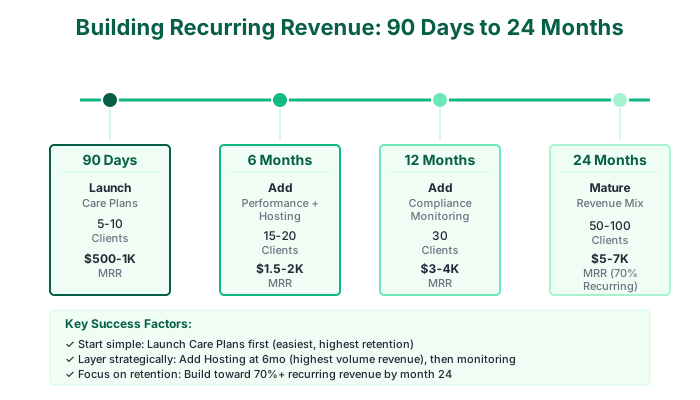
The key metric to track: MRR growth month-over-month. Target 5-10% growth from your existing client base through upsells and cross-sells. New client acquisition adds on top. At 5% monthly MRR growth, you double your recurring revenue in 15 months.
Wrapping Up
Five recurring revenue models. Care plans and compliance monitoring win on margin. Retainer hours win on premium billing rates. Hosting resale wins on simplicity. Performance monitoring is the versatile middle ground. None of them is wrong — but stacking multiple models is where the real leverage lives.
Start with care plans. They're the highest-margin, most proven model for WordPress agencies, and your existing clients are the easiest conversion. Layer performance monitoring and hosting resale by month six. Add compliance monitoring by month twelve as regulatory pressure builds. At 24 months, aim for 70% recurring revenue. That's how you stop trading time for money and start building something that compounds. The agencies that figure this out in 2026 are the ones still growing in 2030.
More from the blog
The WordPress Agency Guide to Reducing Client Churn Below 5%
WordPress agency churn is silent and expensive. Master the three levers that drive retention and build sustainable recurring revenue.
WordPress Care PlansWordPress Maintenance Plan Template (Free Download)
Build a three-tier WordPress maintenance plan template with client-facing language, structured pricing, and automated reporting that retains clients.