How to Price WordPress Care Plans in 2026

Most WordPress agencies underprice care plans. A solo shop quotes $49/month for "maintenance." A small team offers $150/month "all-inclusive." Both leave 50-70% revenue on the table. The problem isn't a lack of pricing models—it's guessing without a strategy. Clients sense uncertainty and push back, turning every negotiation into a losing game.
In this post:
The Three Pricing Models That Work
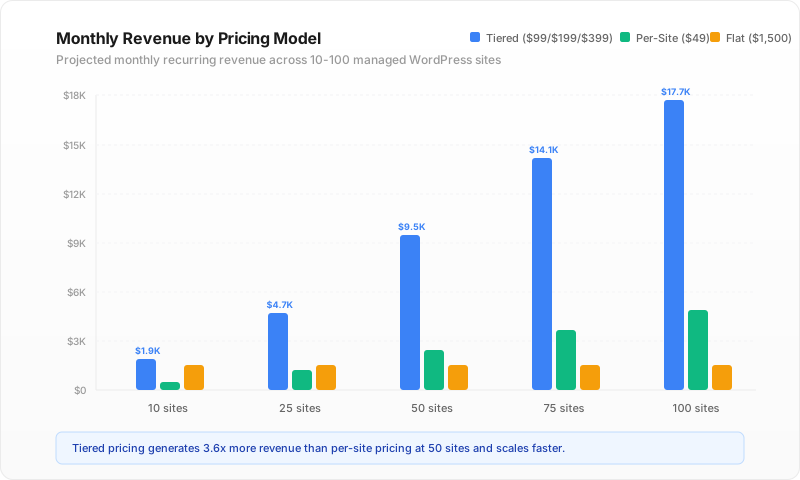
WordPress care plan pricing falls into three clear categories. Pick one model, document it, and own the decision. Each has different psychology and scaling mechanics.
Model 1: Tiered Pricing (Most Common)
Three tiers with clear feature differences. Clients self-select based on need and budget.
| Tier | Monthly | Annual | What's Included |
|---|---|---|---|
| Basic | $99/mo | $990/yr | 2 hours/month support, security updates, daily backups |
| Standard | $199/mo | $1,990/yr | 5 hours/month support, performance optimization, plugin updates, monthly reports |
| Premium | $399/mo | $3,990/yr | 10 hours/month support, SEO monitoring, quarterly security audits, strategy calls |
Why tiered pricing works: Clients anchor to the middle tier. Basic feels like a second-class option. Premium feels exclusive. You present all three and land on Standard 60% of the time. The annual option doubles commitment because "save 2 months" feels like a deal.
Model 2: Per-Site Pricing
Charge per site, not per client. You have 15 clients with 40 total sites? Charge $79–$149/site/month based on complexity.
The math: 40 sites × $100/month = $4,000 MRR recurring. That's a full-time salary dedicated to care plans alone. The drawback: You hit a scaling ceiling around 50–60 sites. Beyond that, you're drowning in work without proportional revenue.
Model 3: Flat Agency Fee
One price for unlimited sites under that agency's account. Example: $299/month covers all their WordPress properties, no matter the count.
Advantage: Simple and predictable. Client doesn't watch costs creep up. You get the same revenue whether they have 3 sites or 30. Disadvantage: You need proof of concept first. Can't sell unlimited pricing to your first care plan client—you'll absorb the cost.
Price Anchoring and Psychology
How you present pricing matters as much as the numbers. The best agencies use anchor pricing and problem-first positioning.
Never lead with price. Lead with the problem: "Most agencies spend 15–20 hours/month on maintenance they could automate. For clients, that's unpredictability—they never know when something will break."
Then show three options. Not "Which do you want?" but "Which set of issues matches your business?" Clients don't want Basic (second-class feeling) and Premium feels like overkill. Standard wins 60% of the time because it feels like the right choice.
The annual pitch matters. "$199/month or $1,990/year (save 2 months)" triggers math. Clients pick annual, giving you 12-month cash upfront. Churn drops 8–12% on annual plans because switching costs feel higher.
73% of WordPress agencies that raised care plan prices in 2025 reported zero customer pushback. They didn't lose a single client. Why? They could justify the price with clear value communication.
How to Justify Your Price With Proof
Clients push back on price because they don't see the work. You fix things invisibly: security patches, backups, plugin updates. Then your invoice arrives and they think, "I didn't ask for anything."
The solution: Show the work every month.
Send a monthly client report. Not long. One branded page. "Your site had 4 security updates applied, 2 backup restoration tests completed, 14 hours of threat monitoring." Clients see consistency. Price becomes reasonable overnight.
Manual reports for 30+ clients each month is unsustainable. You'll skip months or send late. The answer: automated reporting. A tool that pulls real WordPress data and fills a clean template means you send perfect, personalized reports every single month in minutes of work.
This is where MantleWP changes the equation. It auto-generates white-labeled monthly reports for all your care plan clients. You set it once, send it automatically, and clients see the value. Retention climbs. Price sticks.
What Clients Actually Read in Reports
- Health score: One number (1–100) or visual. Instantly clear.
- Key metrics: Uptime (99.8%), load time (2.1 seconds), security status (0 threats).
- Work this month: 3–5 plain-English bullets. Not technical jargon.
- Issues resolved: Bold and dated. What happened and when.
- Next month: What's coming. Shows proactivity.
Branding matters too. A white-labeled report with the client's logo and your agency name feels premium. Clients share it with their team. That's social proof of your value.
Ready to implement pricing that sticks? Start with our pricing guide, then set up automated reporting to justify every dollar. Sign up free to generate your first white-labeled report in minutes.
Wrapping Up
The agencies winning in 2026 stopped guessing on price and started communicating value. Tiered pricing works because it feels like client choice. Annual discounts work because they feel like deals. But nothing works without visible proof of work.
Pick your model, document it, price your current clients fairly (grandfather existing clients if you're raising rates), and send monthly reports. Your clients don't leave because price is too high. They leave because they don't see why they're paying at all.
For deeper insights on building care plans that stick, read Why Your Clients Don't Read Your WordPress Reports and The WordPress Agency Guide to Reducing Client Churn Below 5%.
More from the blog
WordPress Maintenance Plan Template (Free Download)
Build a three-tier WordPress maintenance plan template with client-facing language, structured pricing, and automated reporting that retains clients.
WordPress Care PlansWhat to Include in a WordPress Care Plan
What to include in a WordPress care plan: the 8 core components, how to tier them, and what separates agencies that retain clients from those that don't.