How to Sell WordPress Care Plans to Existing Clients

Your existing clients are your easiest care plan sale. They already trust you, know your work quality, and need ongoing WordPress maintenance whether they realize it or not. Yet most agencies never ask. The conversion rate from existing clients to care plan clients runs 40-60% — compared to 5-10% for cold prospects. Zero acquisition cost. Higher lifetime value. The only thing missing is the playbook to close.
In this post:
Why Existing Clients Are Your Easiest Sale
Cold prospect conversion takes months of nurturing and converts at 5-10%. Existing client conversion happens in two weeks and closes at 40-60%. The economics are different in every dimension: zero customer acquisition cost, proven trust, and a higher lifetime value because the relationship has already survived the hardest part — the first project.
One client paying $59/month for a care plan adds $708/year in recurring revenue from someone who's already in your CRM. Multiply that across 15 existing clients at a 50% conversion rate and you've added $5,310 in annual recurring revenue without spending a dollar on marketing.
Existing clients close at 40-60% on care plans. Cold prospects close at 5-10%. Your easiest revenue is sitting in your client list right now.
When to Approach
Timing matters. The four best moments to pitch a care plan: right after project delivery (the site is fresh, trust is highest), after six months of site stability (you can point to the ongoing work you've already been doing), right after fixing a maintenance issue (the pain is real and recent), and at the annual renewal conversation. The worst time is mid-project when the client is focused on delivery, not long-term maintenance.
Framing Care Plans: Insurance Plus Proof
Care plans fail when agencies position them as "extra maintenance." Clients hear "more money for something I don't see." The frame that works is insurance plus proof. Insurance: you're preventing downtime, security breaches, and plugin conflicts. Proof: a monthly report that shows the work being done.
Without reports, care plans feel invisible. You patch vulnerabilities at 2 AM, test backup restores, and monitor uptime — the client sees none of it. Then the invoice arrives and they think, "I'm paying for what, exactly?" With monthly automated reports, the client sees: 4 security updates applied, 12 plugins scanned, 99.8% uptime, 2 performance optimizations completed. The care plan shifts from abstract cost to concrete insurance. That's the positioning shift: from "extra service" to "essential protection."
The 3-Email Sequence That Works
Three emails over two weeks. Soft introduction, social proof, then the ask. This sequence converts at 40-60% with existing clients because it respects the existing relationship while building urgency.
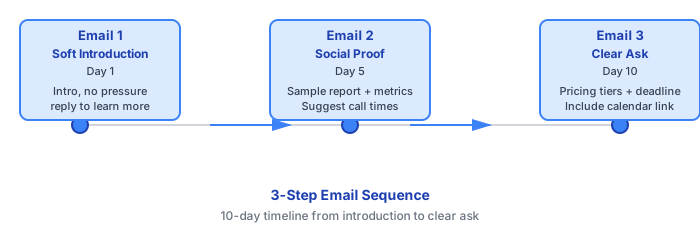
Email 1: Soft Introduction (Day 1)
Subject: A new way to protect your WordPress site
"Hi [Client Name], We've been managing your site for [X months] and it's running well — stable, secure, and performing. Over that time we've applied [X] security updates, resolved [X] issues, and kept everything compatible. We're now offering WordPress Care Plans: ongoing monitoring, maintenance, and monthly reports that show you exactly what's happening with your site. No pressure — this is just to introduce the idea. If you'd like to learn more, reply and we'll set up a quick call."
Tone: informational, zero pressure. The only ask is "reply to learn more."
Email 2: Social Proof (Day 5)
Subject: Here's what your monthly care plan report would look like
"Hi [Client Name], Following up on my note about Care Plans. Here's a sample of the monthly report you'd receive — [attach or embed screenshot]. Key highlights: uptime 99.8%, 3 security updates applied, 0 vulnerabilities found, 2 performance optimizations completed. Our care plan clients see 40% fewer WordPress issues because we're monitoring proactively instead of reacting to problems. Would Thursday at 2 PM or Friday at 9 AM work for a 15-minute walkthrough?"
Tone: solution-focused. The sample report is the proof that makes the abstract concrete. The CTA moves to scheduling — a soft but direct step forward.
Email 3: Clear Ask (Day 10)
Subject: WordPress Care Plan pricing for [Client Name]
"Hi [Client Name], Based on your site's complexity, here's what I'd recommend: Premium Plan ($99/month) — full monitoring, priority 24-hour support, advanced optimization. Standard Plan ($59/month) — core monitoring, security updates, plugin scans, monthly branded report. Both include everything: monthly reports, backup verification, performance audits, and proactive notifications. I'd like to get you set up by [date]. Let me know by [earlier date] if you'd like to move forward, or pick a time to discuss: [calendar link]."
Tone: direct, assumptive. Lead with the higher price (anchoring), then show the standard plan as the natural choice. Add a deadline to create gentle urgency.
Handling Objections With Scripts
Four objections cover 80% of "no" responses. Each follows the same pattern: acknowledge the concern, agree with the premise, then reframe. These are copy-paste ready — adapt the specific numbers to your agency.
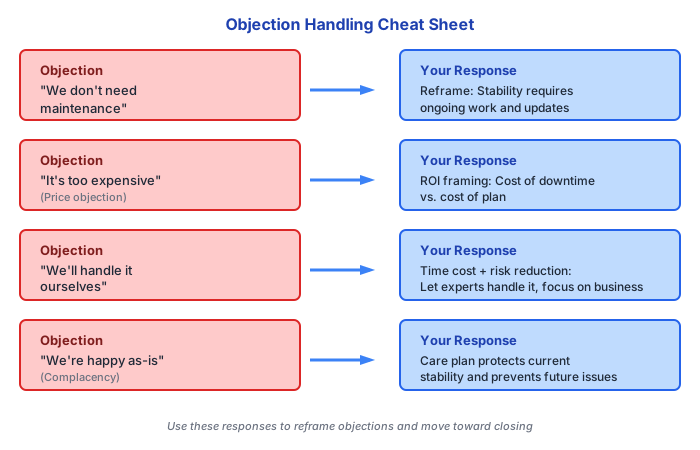
"We don't have maintenance needs"
"You're right — your site is stable. And that's exactly why a care plan makes sense. Stability requires ongoing work: monthly security updates, plugin compatibility checks, performance monitoring, backup verification. You don't see this because it's working. A care plan keeps that stability ongoing. Without it, you risk a plugin conflict or security vulnerability breaking what's currently working. The care plan isn't fixing problems — it's preventing them."
"It's too expensive"
"I get it — $59/month feels like a lot. But consider the cost of one hour of downtime for your site. Or a security breach, which averages $10K-$50K in recovery for small businesses. The care plan is $708/year — insurance against something that could cost ten times that. Plus, you see the value every month in your report. That usually changes how the cost feels."
"We'll handle it ourselves"
"You absolutely can. But here's what we see: when site owners handle maintenance, about 1 in 20 updates breaks something, plugins conflict without warning, and backups never get tested. There's also the time cost — an hour per month adds up to 12 hours per year. For $708/year, you're buying back that time and reducing risk. We do this 50 times a month across client sites. We're better at catching edge cases. Let us handle the maintenance, you focus on your business."
"We're happy with our current setup"
"Great — stability is the goal. A care plan doesn't change your setup. It ensures it stays stable. Right now, updates happen manually or are deferred. With a care plan, we handle everything proactively and send you a monthly report proving your site is secure and performing. It's a safety net, not a change. One question — when was the last time someone tested your backup restore? Most site owners never test. That's something a care plan covers."
Pricing Anchoring and Psychology
Never lead with your target price. Lead with the premium tier, then present standard as the natural choice. This is anchoring — the higher number makes the lower number feel reasonable.
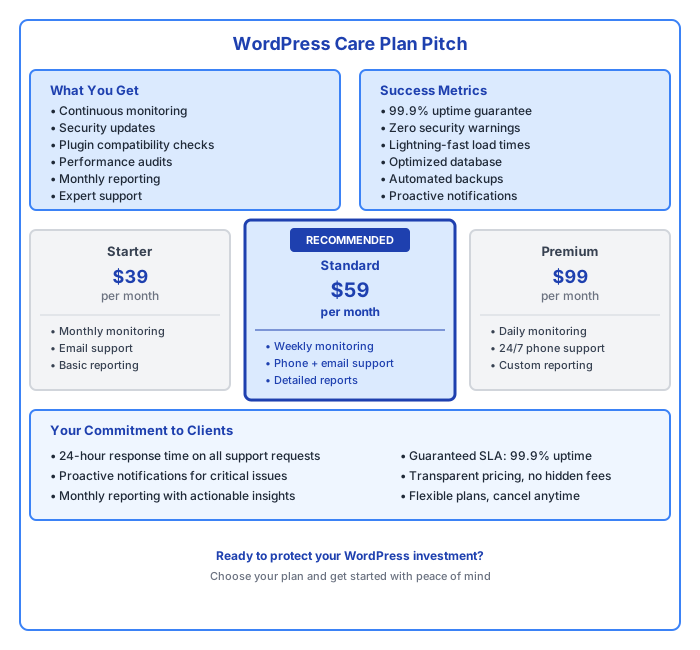
Three tiers work because clients self-select. Starter ($39/month): basic monitoring, weekly uptime checks, monthly summary email — for clients who want the minimum. Standard ($59/month): full monitoring, security updates, plugin scans, monthly branded report — this is your target tier, and 60% of clients pick it. Premium ($99/month): everything in Standard plus priority 24-hour support, advanced optimization, and quarterly strategy calls — for clients who want the white-glove treatment. The psychology: don't say "$59/month." Say "peace of mind — monthly reports showing your site is secure and performing well." Clients buy outcomes, not line items. If you're still dialing in your care plan pricing tiers and psychology, start there.
The Role of Automated Reporting in Care Plan Sales
The biggest reason care plan sales fail is that clients can't see the value. They pay $59/month but don't know you're monitoring their site. Monthly automated reports solve this. Clients see exactly what you're protecting: uptime percentage, security status, performance metrics, plugin health. With your agency logo and colors throughout. The care plan stops feeling optional and starts feeling essential.
What makes a good monthly report: an executive summary (3 sentences a non-technical client can understand), health metrics (uptime, security, performance), work completed (updates applied, issues resolved, optimizations made), and a forward-looking recommendation ("here's what we suggest for next month"). That last piece turns a maintenance relationship into a strategic partnership. Agencies sending monthly branded reports see 20-30% lower churn because clients receive proof of value every 30 days. The report is the retention lever. For what that report should look like and why most reports get ignored, check why clients don't read WordPress reports and fix the format first.
Monthly reports are the highest-impact retention tool — but writing 40+ per month manually isn't sustainable. See how MantleWP automates branded care plan reports for unlimited sites. Five minutes of setup, 30 seconds per month to confirm each send.
Closing the Sale
Don't ask "would you like to talk about this?" That's too easy to say no to. Move straight to scheduling: "I've blocked Thursday at 2 PM and Friday at 9 AM to walk you through exactly how this works. Which works better?" The shift from concept ("should we discuss?") to logistics ("which time?") changes the psychology entirely.
The sales call itself takes 15 minutes. Show one sample branded report (7 minutes). Explain the three metrics clients care about most — uptime, security, performance (3 minutes). Answer questions (3 minutes). Present annual pricing with the monthly comparison (2 minutes). Close: "Great. You'll get your first report by [date]. I'll have monitoring set up by [date]." No "do you want to do this?" — assume the yes and move to logistics.
If no response after Email 3, wait 3-5 days, then send one follow-up: "Still interested in discussing? Here's the calendar link again." If still no response, move on. Never follow up more than once — it kills momentum and feels desperate. Some clients come back months later when something breaks.
Wrapping Up
Your existing clients close at 40-60% on care plans. Cold prospects close at 5-10%. The math is obvious — your best revenue opportunity is sitting in your current client list. Frame care plans as insurance plus proof (not "extra maintenance"). Use the three-email sequence over two weeks. Handle the four common objections with the scripts above. Anchor your pricing with premium first. And make automated monthly reports the centerpiece of every pitch — they turn invisible work into visible proof.
Send the first email this week. Test the sequence with one existing client. If the response is positive, scale to your full list. At 50% conversion across 15 existing clients at $59/month, you've just added $5,310 in annual recurring revenue from relationships you already have. The emails and scripts do the heavy lifting. You just have to ask.
More from the blog
WordPress Agency Recurring Revenue: 5 Models That Scale
WordPress agency recurring revenue comes from five models: care plans, retainers, hosting, performance, and compliance monitoring. Compare margins, stack them, and hit 70% MRR.
WordPress Care PlansWordPress Maintenance Plan Template (Free Download)
Build a three-tier WordPress maintenance plan template with client-facing language, structured pricing, and automated reporting that retains clients.