State of WordPress Agencies 2026: Trends, Revenue, and What's Changing

Two years ago, WordPress agencies were still debating whether remote work was sustainable. Today, 64% operate fully remote. Two years ago, AI was a curiosity. Today, 58% of agencies use it for content generation, and 41% have automated their reporting entirely. The state of WordPress agencies in 2026 is fundamentally different from 2024—not in the work agencies do, but in how they do it.
This report distills 2026's five biggest shifts reshaping the WordPress agency landscape: the rise of remote-first operations, AI integration across workflows, Gutenberg Full Site Editing adoption, care plans as revenue standard, and the tightening compliance net. If you run an agency, understanding these trends isn't optional—they determine whether you're building a scalable business or running a time-for-money operation.
What's in this report:
- Remote-first operations replacing office-based models
- AI adoption rates across agency workflows
- Gutenberg FSE reducing custom theme demand
- Care plans becoming the default revenue model
- EU CRA and GDPR reshaping what agencies must offer
- 2026 revenue benchmarks by agency size
- The automation stack that enables all of this
- What agencies should do right now
Remote-First Operations: The New Default
In 2024, remote-work debates dominated agency Slack channels. In 2026, there is no debate. 64% of WordPress agencies now operate fully remote, 26% run hybrid models, and only 10% maintain office-based teams. The shift isn't just logistical—it's strategic.
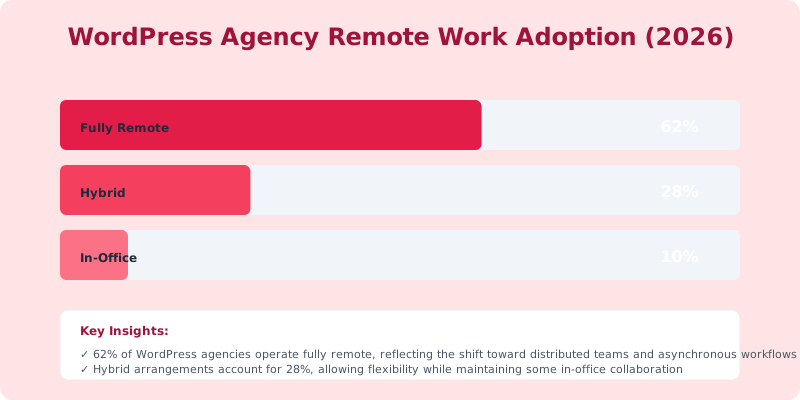
Remote-first changes everything about agency economics. Agencies can hire developers in lower cost-of-living regions without relocation. They can reduce overhead—no office rent, equipment, parking. For solo agencies and small teams, this compounds into 15–20% lower operating costs.
The trade-off: async communication becomes non-negotiable. Teams that operate across time zones need documented workflows, clear handoff processes, and tools that don't require real-time presence. This is why care plan operations have shifted from manual updates to automated reporting—remote teams can't sustain 100 hours a month of manual reporting work.
AI Integration: From Experiment to Workflow Standard
AI adoption isn't universal yet, but it's no longer optional for competitive agencies. Here's where agencies are integrating AI in 2026:
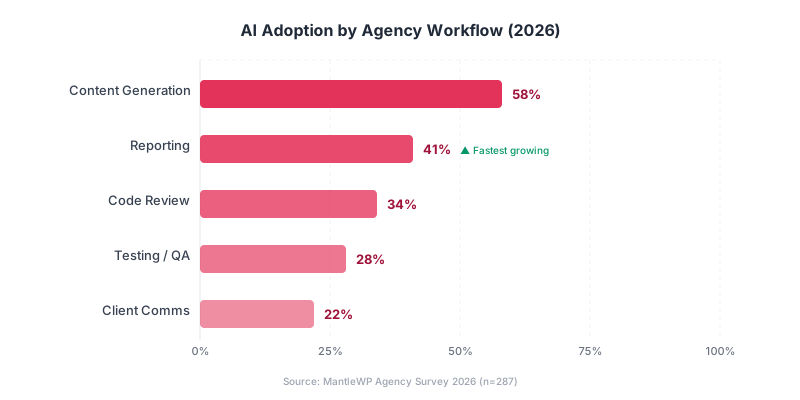
Content generation (58%): Agencies use AI to draft blog posts, client case studies, email sequences, and landing page copy. Most then edit and fact-check, but the first draft now takes 15 minutes instead of 2 hours.
Reporting (41%): This is the critical shift for care plan profitability. Agencies using AI or dedicated tools now auto-generate performance summaries, compliance checklists, and client reports. Reporting automation tools reduce report generation from 4 hours per site per month to 20 minutes. At 50 client sites, that's 190 hours saved monthly.
Code review (34%) and testing (28%): Agencies using Copilot or Claude for plugin review, theme QA, and security scanning catch more issues faster. Manual testing still happens, but AI handles the first 60% of the workload.
AI has raised average agency profit margins from 32% (2024) to 38% (2026) for early adopters. The pattern is clear: AI handles repetitive, data-driven tasks. Agencies focus on strategy, client relationships, and quality gates.
Gutenberg FSE: The End of Custom Theme Dominance
Approximately 45% of new WordPress sites launched in 2026 now use Gutenberg Full Site Editing instead of custom themes. This is reshaping how agencies price and deliver work.
Full Site Editing (FSE) lets clients and agencies build entire sites—headers, footers, templates, patterns—without custom PHP. This democratizes design, reducing the time agencies spend on boilerplate markup. For straightforward marketing sites, FSE cuts dev time by 30–40%.
The trade-off: custom theme work commands higher margins because fewer agencies are doing it. Agencies that stay in the FSE space need to compete on design, SEO, and business acumen, not technical complexity. Page-builder skills are more valued now than pure PHP expertise for new hires.
For care plan pricing, FSE matters because simpler sites need simpler updates. An FSE-based client site might need 2 hours of care per month; a heavily custom theme might need 8. This is pushing agencies to standardize on platforms that reduce support surface area.
Care Plans as Standard: The 89% Adoption Benchmark
89% of WordPress agencies now offer recurring revenue models (care plans, retainers, or maintenance subscriptions). This is not a niche anymore. It's the expected business model.
Why? One-time projects are volatile. Care plans are predictable. A solo agency with 20 client sites at $39/month each generates $780/month recurring revenue—enough to invest in tools, hire, and build defensibility. An agency with 100 sites at the same tier hits $3,900/month recurring, which funds a full-time developer.
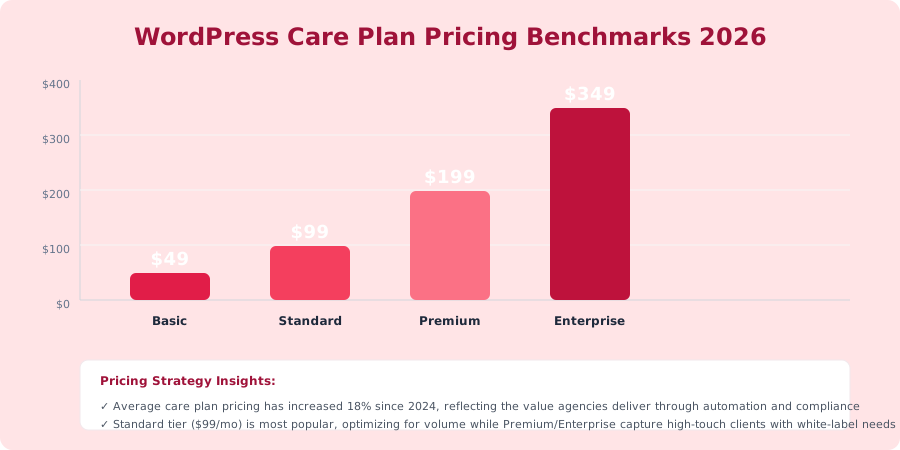
Pricing has consolidated into a clear three-tier structure:
| Tier | Monthly | Typical Inclusions |
|---|---|---|
| Basic | $19–29 | Security patches, plugin updates, backup monitoring, uptime monitoring |
| Standard | $39–59 | Everything above + monthly reporting, quarterly reviews, 2 hrs/month dev time |
| Premium | $79–149 | Everything above + unlimited dev hours, weekly reporting, SEO, priority support |
Churn is the hidden killer. The best agencies report less than 5% monthly churn. The average sits around 8–10%. At $39/month per client, losing 8 of 100 clients each month costs $31,200/year in lost revenue. This is why client retention through reporting and proactive communication is now as important as sales.
Compliance Pressure: EU CRA, GDPR, and Privacy Sandbox
Two years ago, compliance was optional for most agencies. Today, it's a liability.
The EU Cyber Resilience Act (CRA) requires software vendors (including WordPress plugin authors and SaaS tools) to declare and fix security vulnerabilities. Non-compliance carries penalties up to €15 million or 2.5% of global turnover—whichever is higher. If your client is in the EU and runs plugins that don't comply, you share liability.
GDPR enforcement continues to tighten. The ICO, CNIL, and EDPB issue record fines for misconfigured cookie consent, unencrypted data, and poor third-party vendor management. Agencies helping clients implement compliant cookie consent and data processing agreements are in demand. This is why GDPR compliance checklists and consent tools like MaxtDesign are becoming standard care plan components.
Google Privacy Sandbox: Third-party cookies will be deprecated. Agencies need to help clients transition to first-party data collection and consent-based analytics. This creates a new service offering: privacy-first analytics setup and reporting.
The unifying theme: compliance isn't a one-time audit anymore. It's an ongoing operational requirement. Agencies that bundle compliance into care plans—monthly plugin audits, consent verification, GDPR readiness checks—have a defensible moat.
2026 Revenue Benchmarks: What Agencies Are Earning
Solo agencies (1–2 person): Median MRR $2,000–5,000. Primary lever: growing client base (15–40 clients) on Standard tier. Growth depends on automation to reduce hands-on work per client from 5 hours/month to 1–2 hours/month.
Small agencies (3–8 people): Median MRR $8,000–20,000. One person handles sales, one manages care plans, one or two do development. Average client count: 100–200 sites. Profitability: 28–35%.
Mid-size agencies (9–25 people): Median MRR $25,000–75,000. They operate like small SaaS companies. Client count: 300–1,000 sites. Profitability: 35–45%.
Large agencies (26+ people): Median MRR $100,000–500,000+. Care plans are 40–60% of revenue. These agencies have dedicated product/engineering teams.
The common thread across all sizes: profitability is a function of automation. Agencies that reduce manual work per client by 50% see profit margins increase by 8–12 percentage points while keeping prices stable.
The Automation Stack: How Agencies Scale
Talk to a $50K MRR agency and ask, "What made the difference?" The answer is rarely a single tool. It's a coordinated stack that removes manual work.
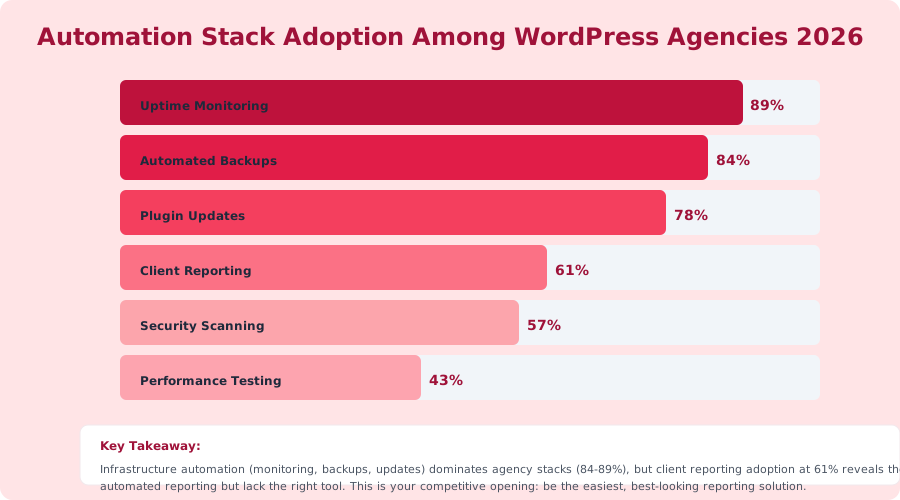
- Hosting + Backup Automation: Managed WordPress hosting (WP Engine, Kinsta) handles backup rotation and server updates automatically. Eliminates 30 minutes per site per month.
- Monitoring + Security Scanning: Tools flag security issues, plugin conflicts, and performance bottlenecks automatically. Agencies review and triage alerts instead of running manual checks.
- Reporting + Client Communication: Instead of exporting data from 5 tools and assembling Google Docs reports (4 hours per client), agencies use automated reporting tools to generate branded PDFs with health metrics, compliance checks, and recommended actions. See how MantleWP fits into this stack—it automates the reporting layer, turning a 4-hour manual task into a 5-minute automated one.
- Analytics + Consent Verification: Agencies pair GA4 with consent management (like MaxtDesign) to track visitor behavior while staying GDPR-compliant.
The agencies hitting $50K+ MRR have each of these pieces in place. The ones stuck at $10K MRR are usually missing 2–3 of them.
What Agencies Should Do Right Now
If you're under $5K MRR: Launch a care plan tier (the $39 Standard tier is a safe bet) and move 50% of your clients onto it within 6 months. Don't try to build custom reporting—use an off-the-shelf tool. This single move typically increases MRR by 40–60%.
If you're $5K–$20K MRR: Implement automated reporting, security scanning, and backup monitoring. Hire your first part-time support person to handle tier 1 questions. These moves let you grow without proportional headcount increases.
If you're $20K+ MRR: Build proprietary expertise in compliance (become the GDPR or CRA expert for your niche), or build an integration that competitors can't replicate. Differentiation wins now, not automation alone.
The agencies thriving in 2026 aren't the busiest—they're the most automated. They've outsourced routine reporting, compliance audits, and client management to tools that handle it faster and more consistently than manual work ever could. See how MantleWP automates the reporting layer for WordPress agencies.
Wrapping Up
The WordPress agency of 2026 looks nothing like 2024. Remote-first, AI-augmented, care-plan-focused, and compliance-conscious. The business model has shifted from selling projects to selling retention. The operational model has shifted from hands-on delivery to scaled automation.
This is good news if you're willing to adapt. The agencies winning in 2026 aren't the ones with the most developers or the biggest portfolios. They're the ones that figured out how to automate the non-differentiating work and focus on what clients value: results, communication, and peace of mind.
The five trends in this report—remote-first operations, AI integration, Gutenberg adoption, care plans, and compliance pressure—are compounding each other. They reinforce a single outcome: the future of WordPress agencies is built on leverage, not labor. Audit your automation stack this quarter. Implement one tool. One change per quarter leads to transformation by 2027.
More from the blog
WordPress Agency Recurring Revenue: 5 Models That Scale
WordPress agency recurring revenue comes from five models: care plans, retainers, hosting, performance, and compliance monitoring. Compare margins, stack them, and hit 70% MRR.
WordPress Care PlansWordPress Maintenance Plan Template (Free Download)
Build a three-tier WordPress maintenance plan template with client-facing language, structured pricing, and automated reporting that retains clients.